Tuesday, June 1, 2010

Old Boats of the Club Part Two, the Double Handers

A look at the double handed boats in the WYC's past.

BY: JOHN COURTER

C-Lark

We had a maximum of 16 C-Larks at some point. We used to also have the area on the far side of the boat ramp to the first pedestrian ramp to store boats. The C-Larks were the double hand training fleet. They were a fat version of an I-14, much more stable with less sail area.

It was a self rescuing boat, but the tanks were small and low in the boat, so when you righted the boat it came up half full of water. There were two small holes in the transom to drain the water. For a long time after righting it you had to be very careful with weight placement. If you moved too far forward, the water would rush to the bow, the bow would go underwater, and water would fill up the cockpit again. Any direction you let the water in the boat roll to would result filling the boat again. The boat would eventually drain completely dry without having suction bailers because the cockpit sole was above the water due to the tanks, except for a small well at the back where the drain holes were in the transom.

If you sat too far aft the back of the cockpit would always have water in it. The solution for most people was to keep plugs in the drain holes unless the boat capsized.The boat would plane, but the bow goes up in the air due to the amount of rocker.I'm sure that my views on how the boat planes had a lot to do with my level of experience at the time, but I thought the boat was very difficult to handle while on a plane. I remember sawing the tiller back and forth trying to keep the boat from capsizing and quite often not succeeding.

These boats were advertised as being able to take 4 people. At times there were 4 people on C-Larks with all their camping gear stowed in the bow to go on Snooze and Cruise.

The C-Lark had a fairly large sail area of 130 sq. ft. for a 14 foot boat. It weighed 275 lbs. I've been told that they originally came without mast partners. Apparently we bent enough masts that we built mast partners. It is believed that C-lark eventually added a partner to the boat. Another modification that we apparently caused to be added was a small triangular shaped tank under the side decks to try to slow turtling of the boat.

420

We acquired the 420s as the double hand teaching fleet when the Laser 2s died.  We had both a Flying Junior and a 420 as demo boats.  One reason I remember hearing for selecting the 420 was that it was slightly bigger.   

420s were the popular inter-collegiate fleet at the time.  Some east coast schools still use 420s, but most of the west coast now uses Flying Juniors.   I find the 420s and Flying Juniors to be very similar.  A sailing article from years ago comparing the FJ and 420 had the opinion from some college sailors that the Flying Junior was a better boat than the 420 because you could hardly get it to plane, thus keeping the racing tighter and better.   

The 420 is 420 centimeters long,  had 110 sq. ft. of sail area and weighed 260 lbs.

More info at:


Alpha One
 
The designer of the Alpha had us sail his prototypes, presumably with an eye to selling us a fleet eventually.  Turns out we discovered the mast needed spreaders when we bent the mast, and the daggerboard well needed a LOT more reinforcement.  We found a couple of other issues, all of which he fixed, but we were never happy enough with its sailing qualities to buy a fleet. Laurelhurst Beach club and Western Washington had fleets. 

One day I was going out to try the club's new Alpha and noticed a girl that was about to go out on a Kite, I asked her if she would like to try out the club's new boat with me. She said yes to going out sailing and yes to marrying me two years later.   

Photo courtesy of:
click for more pictures.


Taser

This was a donation.  It was a high performance, no spinnaker, no trapeze boat.  It had a rotating mast like the Hobies and a fully battened main.  It was 14' 10” long, weighed 150 lbs, and had 123 sq. ft of sail.  It wasn't in the club for very long.  I don't remember much about it, I'm not sure I even got to sail it.  I believe that it was considered too fragile to keep.

Photo courtesy of:
click for more info.


Tuesday, April 27, 2010

Cartwheel Grounding

Check out this video of the Asko skiff's cartwheel grounding at the 2007 18 ft skiff World Championship.

POSTED BY: KEN INOUE

Wednesday, April 7, 2010

Keelboat Skipper Class Sees High Winds Last Weekend

Recounts of the keelboat skipper class overnight cruise to Kingston April 3-4.

STORY COMPILED BY SCOTT VOLTZ

South Winds Saturday of 15 to 25 knots drove the three club keelboats to Kingston.  Mostly on a broad reach, the fleet later beam reached into the harbor.  Platypus came across from Edmonds to join wearing only a lapper. Crew Connie did a great job dragging down the lapper in the stiff wind. We decided to take advantage of the almost free reciprocal moorage and forgo anchoring, a good decision because the next morning the anchoring area was pretty rough as the wind had clocked around toward the east. Everyone cooked aboard and went to town in the evening.

Sunday morning found all three club boat engines with their covers off. Deception had idle problems. Rascal has no reverse. Charlotte had a broken starter assembly. Deception and Rascal got off the dock first as the crew on Charlotte tried to repair the starter assembly. They finally gave up trying to get the starter assembly to work. Then they could not get the engine started using a length of cord with a knot in it. Something else was wrong. We thought about the neutral lock-out switch but were not sure where it was. It turns out we should have tried a little harder to figure that one out.

With Rascal and Deception already winging their way toward Shilshole, we prepared Charlotte and Platypus as much as possible for sailing. Then Platypus towed Charlotte out around the breakwater. The rollers were steep and it was a challenge raising the sails. From the cockpit of Platypus I could see the bow of Charlotte bouncing high into the air as Brandea and Helgi rode it like a bucking bronco. Platypus barely made headway with her engine at full throttle trying to pull Charlotte out far enough so she could get on a starboard tack to clear the ferry dock.

Both Charlotte and Platypus were double reefed. Charlotte had a lapper, Platypus a storm jib. It took a couple of hours to get across the sound and the wind kept building and building. I measured a steady 20 knots with gusts to 24 and know it got worse than that because I sure didn't want to take measurements when fighting the helm and wiping salt water off my face. Connie and I were both soaked. A close reach which normally would have taken us to the marina entrance instead took us pretty far north of Edmonds as we were blown sideways and forward.  We finally got near to land where it was slightly more sheltered and could tack south. We ran the diesel full out and had both sails drawing to inch our way toward the marina. We dropped sails very close to the entrance and I spent few seconds out on the deck lashing down the sails.  My goal had been to stay off the foredeck and in the cockpit. Then we headed to our slip where a kind neighbor took our lines for us.  We changed into dry clothes and listened to the VHF radio.

Got a hail from Charlotte as she considered giving up the attempt for Shilshole. We left the radio on channel 69 as they had a quick crew meeting to decide.  I believe Rascal and Deception with their head start were able to make a better run for home and quite possibly they got across into the shelter of land before the really high winds hit the Edmonds area. The crew on Charlotte, faced with over 30 knots of wind decided to shelter over in Edmonds. They hailed us on the VHF and asked for a tow. I brought Platypus back out into the maelstrom and found Charlotte just off the breakwater with a double reef and a storm jib. We towed her into the guest dock where she stayed for two nights. I think the decision to shelter in Edmonds was a very good one. Discretion is the better part of valor.

Helgi, Brandea, Fred, and Bill are headed to Edmonds Tuesday the 6th to bring Charlotte back to the WAC.  Here is the wind speed chart from the Edmonds area on Easter Sunday:


The next day we started an email discussion about the weekend. Here are some excerpts:

Fred on Deception:

We left the Kingston docks with our sails ready to hoist, lapper and main with single reef (~11am). After raising both sails we quickly felt overpowered with the lapper and changed to the storm jib. We seemed well enough balanced with this setup and made a few tacks to leave Appletree Cove. We crossed the shipping lanes to be on the east side of Puget Sound. From there we pretty much had a straight shot to Shilshole on port close-haul/close reach, arriving ~2:30pm. Winds were definitely strong (20-25 knots?).

We sometimes wished we could go to a double reef in the mainsail, however the reefing system was such that we would have to untie the reefing line from the first reef cringle on the leech and re-tie it to the second reef cringle. We felt that the risk of losing control of the sail in the process was worse than the minor over-powering we were experiencing. We put the traveler down to our taste, luffing/bubbling the luff to various extents. We made it to Shilshole fine, average speed over ground ~3.5 knots. We had a good sail, Bill and Erik did a great job.

I’ve attached the pdf of our sailing track for April 3&4 for Deception.
Fred

From Helgi on Charlotte:

Some things I can add to the list of things which may help. I'd like to mention first that I have sailed very comfortably in 25 kt winds with gusts to 32, and that yesterday's wind reached in excess of 30 for a long time near Edmonds, with gusts way above that (ask yourselves how much wind it takes to deeply heel a double reefed boat flying a storm head sail).

1) Try to break the crew up into shifts. This can be difficult when you only have three people, but I found that this gives the helmsman a break, and also gives the other's in the crew a chance to learn what their limits are (I believe that both Andrew and Brandea found themselves able to steer well in winds much much higher than they thought they were able to).

2) Have Dramamine onboard, and take it if you even suspect that you are going to be seasick. None of us got too ill, but it may have been getting close, and loosing a crew to seasickness significantly increases stress on the rest.

3) Reef deep, reef early.

4) Rig jack lines (http://en.wikipedia.org/wiki/Jackline) and wear a harness, even in the cockpit. Though we didn't actually capsize, we were whipped a couple of times way too close.

5) Have a hand on the main sheet, and be ready to blow it.

6) Secure every single thing in the cabin (boy, did we have a mess on our hands when we docked).

7) Be ready to give up and seek shelter. Think of back up plans to back up plans. Mine was ducking into Holmes Harbor if Scott hadn't been able to tow us into Edmonds.

My 2 cents. Helgi

And from Jeremiah on Rascal:

First of all, I'd like to say that the crew of Rascal (Nikita, Jason, and Mark) handled themselves beautifully this past weekend. Any mistakes that were made were minor and were dealt with comfortably and calmly.

As we left Sunday morning and neared the entrance to the marina we could see that the breakwater was doing it's job. The bay was quite choppy out there. Once we rounded the jetty Nikita put us into the wind to raise the sails. However, the sails and rigging weren't quite ready and the motor popped out of the water once or twice. Nikita promptly put the boat at a diagonal with respect to the waves and fixed that problem while the rest of the crew readied sails and rigging. Sometime later the sails came up. We were running the main with one reef and the lapper. (Maybe we should have communicated the conditions to the rest of the boats, so that you could have been prepared? Did anyone have their radios on, so we could communicate back to you?).

Lesson #1: Ready your sails and rigging at the dock, so that you're ready to raise them within minutes of rounding the jetty. Sailboats are much happier sailing than motoring.

Nikita steered us on a starboard close-hauled tack. I noticed that he was fighting the helm a little. I suggested that the rest of the crew join me on windward side of the deck. Not only did Nikita have an easier time steering, but with less heel we accelerated to slightly faster than hull speed. That was a lot of fun!

Lesson #2: Hull trim (or weight distribution) is just as important as sail trim.

For a while we were racing the trimaran. I think you can guess who won. In fact, I'm not even sure that they knew we were racing them ;) For about 30 seconds the trimaran was flying both hulls and just screaming down the sound. I think that it scared them a little because I didn't see them do that again.

We followed a similar route that Fred showed. Our primary goal was to get to the windward side of the sound, where the waves were bound to be smaller. We were right. As the wind started building even more, the crew decided to reef the lapper. It was definitely a smart move. This time Nikita offered to go forward to reef it. He did a good job. It wasn't quite "rodeo" style but good none-the-less. Then the crew decided to put in a second reef in the main. Unfortunately, while the sail was flogging a small tear in the main that we had noticed developed into a large rip. We immediately doused the main and motor-sailed the rest of the way with a reefed lapper. Everyone (except me of course) took turns at the helm. Everyone did very well controlling the boat under these difficult circumstances.

Lesson #3: From now on, I'm carrying sail and/or duct tape in my sailing bag, so that I can fix small tears before they develop into big rips.

Lesson #4: A major lessoned learned this weekend was that an overpowered boat doesn't necessarily translate to more speed. Often the extra power translates into lots of heel (= more drag) or lots of weather helm (= more drag) and makes it difficult to control. More than once, the crew noted that reefing did not necessarily reduce boat speed but it did make it much easier to control the boat.

And from Goran who went to the Edmonds marina to take a look at Charlotte's engine.

"I am in Edmonds and have just got the engine started on Charlotte. It seems that the gear selector is a bit loose and the neutral safety device was not in exactly the right place so I bypassed it and the engine is running now. I also installed a new recoil assembly.

And Dennis' comments:

This is the 3rd time that has needed to happen that I know of. We should take a couple of pictures and show folks how to do it. It is VERY simple. Pull the wire off the switch, they are automotive type push plugs, male and female so the engine part can be just plugged together. I would permanently disconnect that switch but for chance that some dummy would start in forward at high throttle.

My two cents after the fact:

Such winds really re-enforce the need for those little safety measures we try to practice.
1. Have a well rested, well fed, healthy crew.
2. Have foul weather gear, not just for chance of rain but huge amounts of salt spray over the deck.
3. Never loosen a halyard or any other line until you are ready to use it.
4. Pre rig sails in the shelter of the harbor so you don't have to do it on the deck of a pitching boat.
5. Have optional plans formulated before you leave the dock.
6. Communicate with the other boat skippers so we can be there to help each other if need be.
7. Keep in radio contact.
8. Be very careful moving around on a boat that is experiencing a "lively" motion.
9. Stay calm, think smart, reassure the crew.

I'm pretty dam proud of everyone on how they conducted themselves this weekend. sv


Deception
++++++++++++++

Crew call Saturday April 3rd at 09:30
Leave dock Saturday April 3rd at 10:30 Puget sound by 12:00 (noon). Run north to Kingson, or south to Eagle Harbor. Back to WAC on Sunday ~4p (est.)

Here are the crew details (Manifest)

Charlotte: 
Designated Skipper: Helgi Felixson
Student Skipper: Brandea
Crew: Andrew

Rascal
Designated Skipper: Jeremiah
Student Skipper: Nikita
Crew: Jason
Crew: Mark

Deception
Designated Skipper: Fred
Student Skipper: Bill
Crew: Erik
Crew: Paul
Platypus
Skipper: Scott
Crew: Connie

Friday, April 2, 2010

From the Penguin to the Kite: Single-handers of WYC's Past

A discussion of boats the club owned in the past.   

BY: JOHN COURTER

Part 1: single handers
 
Penguin:
They were 11.5 foot wooden or fiberglass  non-self rescuing (at least back when the club had them) cat rigged single or double hander. 72 square foot sail, 180 lbs.   The club acquired a fleet sometime in the late 1950's. They were long gone when I joined the club in the fall of 1976.
I asked Norm and Ralph what they remember of the boats.
 
Norm:
As I recall we had 8 cyan/aqua glass Penguins when I joined in 1966.
They and one (maybe two) wood hull(s) were on a rack in the canoe house.
We used a dolly to launch them down the ramp into the cut.
 
Ralph:  
Yes.  A fc named Evan Engstrom and several of us built these racks.  I don't remember the dollies, but how else would they be launched.   We could probably find plans on the internet-- or certainly thru WoodenBoat magazine.   Ah yes, coffin corner.  rj>

Norm:
Cat rig, removable stayed masts, sailtrack/slides, loose-footed main.
Hard chines, vertical transom, little rocker. Plywood sheet floorboards
1-2 inches off the hull. The club (I think) put styrofoam sheets under
the floorboards to help them in a capsize but they floated about as
high as an old Lightning when swamped.
 I don't think they planed much if at all. Usually something broke if you
tried.
A common way to capsize in summer was to sit in "coffin corner", flat
on the floor with your back against the transom and your arm over the
tiller, and then jibe. You blocked the tiller so you couldn't round up
and you were stuck there while it rolled on you. Resting your arm
on the tiller in this position could also jack the rudder off the
transom, another fun ride.
Another fun prank was to sail by someone with their boom out and unhook
their clew. The "Phantom UnClewer" had many a victim.

Ralph:
I thought this was in the Kite era, since they used the "two
pronged bracket" and swaged wire rope for their outhaul.  --rj

Norm:
The wood centerboard often broke off the bit around the hinge pin when
people (ahem..) sailed up the ramp without raising them (easy to do with
a southerly). After my contribution to this research I became the Penguin
fleet captain and fixed this a lot. The bronze pin was captured in two
3/8 inch pipe nipples and caps threaded into the sides of the trunk.
For a while I replaced the pin with a wood dowel which acted as a fuse,
but I had to replace them regularly due to wear/sogginess. I should have
varnished them ;)
Ralph might remember more about the wood ones and how many we had in 1961.
I recall rumors of as many as 12.

Ralph:
Sorry I don't.  --rj

Pictures of the Penguin at:   http://www.penguinclass.com/

Pico:
The Pico was our first attempt at a polyethylene boat sometime in the 90s.  We had both an Escape and a Pico brought out as demo boats.  I wanted to demo the Escape and the dealer tried to talk me out of the Escape so he talked me into also demo-ing the Pico.  The Pico was a much better built boat and the Escape went back with a hole in it.  After much debate some months later a Pico was purchased to evaluate if it was strong enough and to find out if the instructors liked teaching and students liked learning in it.  The instructors weren't interested in even trying the boat out in their classes and the boat was sold off as an orphan boat after a few years.  The Pico is 11.5 feet long, has 55 sq. ft. sail area, and the hull weight is 154 lbs.   The mainsail reefs/furls around the mast like the Bravo, but you have to disconnect the vang and there is no furler line, you just grab the mast and rotate it. 

Pictures of the Pico at: 

Tech Dinghy:
This was a donation that we had for a time.  Few people sailed it.  A story from the old timers says that the P.E. department had a sailing program using Tech dinghies and their students were told to sit in the middle of the boat for safety.  Apparently our club members took great delight in sailing circles around them while hiked out annoying their instructors.
The Tech dinghy is 12 1/2 feet long, cat rigged, and weigh about 200 pounds.

Norm:
Regarding Tech Dinghies, there were four made by the Beetle Boat Works
that belonged to the P.E. department in the canoe house then. I don't
know if the club ever owned them or acquired others. The instructor
was very paranoid about wind and they would be coming in while we
were launching Penguins or Huskies.  

Ralph:
After the PE dept stopped giving classes we had access to them.  I don't recall how they were disposed of.   If memory serves(?), Larry Jasman (chief and binary barge throttle jockey) had taken the PE class.   --rj

Kite:
11 foot self rescuing fiberglass cat rigged single hander.  They were acquired approximately 1970, and I don't remember exactly when, but it was probably the early 80's that they were sold. The one named Ralph Jackson was given to Ralph for all the work he put into the club and because the Kite was his favorite boat.  The club had at least 8 of them, and they were the single hand teaching fleet.  The Kite was designed as a junior trainer for the Finn.  It had a solid round tapered wood mast that was stepped right at the bow of the boat.  I was told that I had to hike off of the transom when running to keep the bow from going underwater due to the weight of the mast up forward.  I remember the 1/2" thick sheets of wax hanging from strings in the sail locker that you would rub on the bolt rope of the sail to make it slide easier up the luff slot in the mast. These were the first boats I went out on.  I liked taking them out for our Friday night races when the wind was fairly light.  The Lasers were the hot new boat that everyone knew couldn't be beaten by anything, and I had a good time beating them on the Kite.  I think the Kite had less wetted surface and so was a little faster in light airs.  The Kite was 11' 7" long,  sail area, 78 sq. feet,  hull 160 lbs, 205 lbs all up.  Note the ski belt that was common for a buoyancy aid at the time on the person sailing the boat. 

Photo from 1980 Daysailor.

Tuesday, March 9, 2010

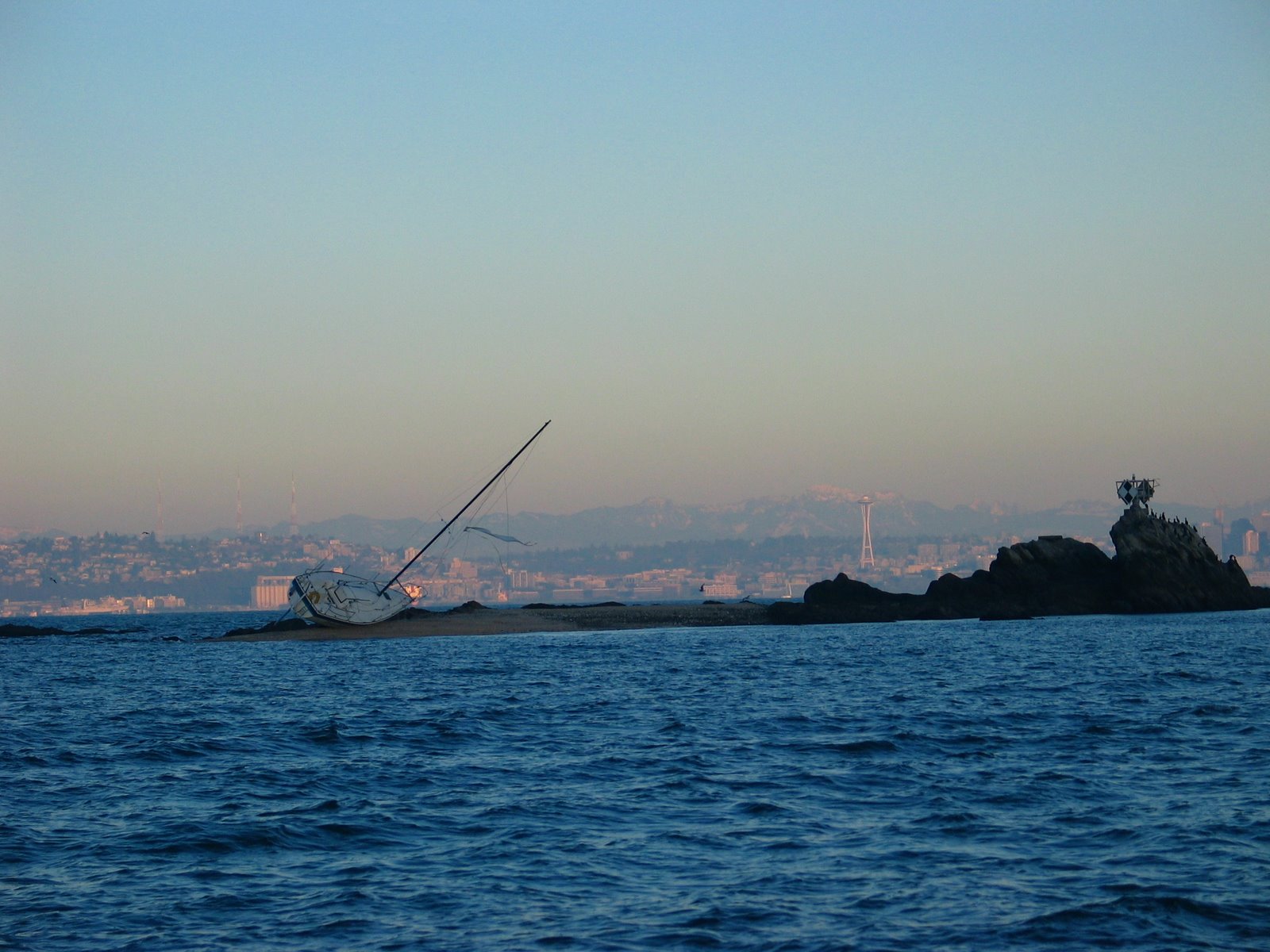
Stomp Dancer Caught High and Dry

At the 2010 Blakely Rock Race, the skipper and crew of Stomp Dancer found themselves out of water after running aground on the sand bar west of Blakely Rock, a fate that befell Tenacious the year before. 

POSTED BY GORAN ZIVKOVC


Looks like there were some familiar faces with wet feet hanging off the leeward shrouds last weekend.  Last year it was Tenacious sitting high and dry, this year it looks like it was Stomp Dancers turn.

Here is an article from Three Sheets Northwest about the grounding, and here are some photos of Tenacious aground last year. 

Wednesday, March 3, 2010

Trigonometry and Views of Mount Rainier

A short report on the intermediate cat class.

BY JOHN COURTER

We had a little wind on Saturday for the class to try to put into practice the near incoherent mumblings about using trigonometry on apparent wind angles, and some sort of insanity about major versus minor axes of the mast affecting how you want to rotate it. The instructor was constantly asking, "What do you think the telltales are telling you?" But we had an incredible Sunday of double trap weather with views of Mount Rainier.


Monday, March 1, 2010

Notes from Last Meeting

A summary of February 16th's general meeting, and what you can expect at the meeting tonight.

BY ERIN JOHNSON

If you're planning on heading out to the WYC meeting tonight, here are some things that happened last meeting, some of which will continue to be discussed tonight. 

There was a lot of talk last meeting about the daysailor handbook, and how it may undergo both content and form revisions. The handbook, which is given to each new member, has information about the club rules and general sailing reference information.  

A pdf version is already available online, but there was discussion about a more interactive version that would include multimedia to help illustrate topics. If completed, members at the meeting questioned the place that printed copies of the handbook would have in the club.You can expect more discussion on this topic. 

Andrew R. proposed a bylaws amendment that would impact the amount of collected membership fees allocated to the new boat fund. Currently 15 percent of all membership fees go toward the new boat fund, which is set aside for the club to purchase boats to supplement the WYC fleet. This number was lowered from 30 percent, after an accident raised the club's insurance rates and required the additional 15 percent to go toward paying that off. 

Now the club's insurance rates have gone back down, so Andrew proposed that we raise the percent allocated to the new boat fund back up to 30 percent. This will be voted on in today's meeting. 

The purchase of new sails was discussed, and will continue to be discussed in tonight's meeting.

Finally, Andrew C. will motion to rename the club's I-14 to "Gotta Skiffy?" 

If for no other reason than to take the bribe of homemade cookies and brownies, be sure to stop by the general meeting in the HUB room 304F at 7 pm.